Tell us about the job
Takes about a minute. No obligation.
A contractor sizing or replacing a water heater in Ritchie County starts by asking what the existing unit has actually been through. 96 severe weather events were recorded in Ritchie County, West Virginia between 2015 and 2024. That puts this county squarely in the middle ground: severe weather is real here, but it is an occasional fact of life rather than a relentless operating condition. Sediment accumulation, a corroded anode rod, or undersized equipment from the original install will account for most of what a contractor finds when they open the job.
Ductwork laid down for one generation of equipment carries assumptions about airflow and capacity that a newer water heater installation has to work around, not with. Half the homes in Ritchie County, West Virginia were built in 1975 or earlier (2020-2024 ACS 5-year). That means a contractor sizing and routing for a new unit is working through what the existing system was built to do, and whether it lines up with what the new equipment requires. The electrical service in houses of that vintage is the same story. What a contractor quotes on a job here depends heavily on what those two systems turn out to be once they are looked at.
What a Water Heater Installation Covers
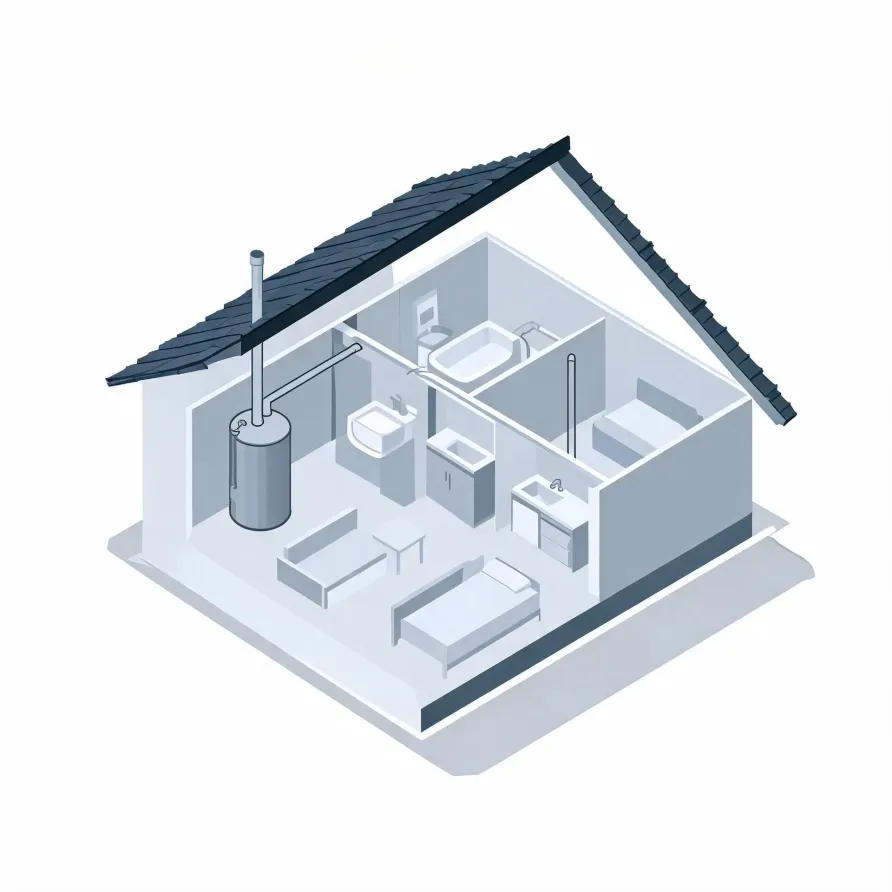
The tank or tankless unit is the heart of the system. A storage tank sits in a utility room, basement, or closet and holds a ready supply of heated water. A tankless unit mounts to a wall in the same kinds of spaces and heats water only as it flows through.
The unit connects to the home's cold water supply line coming in and a hot water line going out to every fixture. A pressure relief valve mounts directly on the tank as a safety device, and the flue or vent pipe runs from the unit to the outside to carry combustion gases away.
The drawing shows a typical layout, and a licensed contractor determines what applies to your specific home.
Find a contractor in Ritchie CountyRitchie County, by the numbers
96 severe weather events were recorded in Ritchie County, West Virginia between 2015 and 2024.
NOAA National Centers for Environmental Information, Storm Events Database, bulk CSV export, events 2015-01-01 through 2024-12-31.Half the homes in Ritchie County, West Virginia were built in 1975 or earlier (2020-2024 ACS 5-year).
U.S. Census Bureau, 2020-2024 American Community Survey 5-Year EstimatesRitchie County, West Virginia holds 4,176 housing units (2020-2024 ACS 5-year).
U.S. Census Bureau, 2020-2024 American Community Survey 5-Year EstimatesOwners occupy 84.2% of the occupied homes in Ritchie County, West Virginia (2020-2024 ACS 5-year).
U.S. Census Bureau, 2020-2024 American Community Survey 5-Year EstimatesSevere Weather Events in Ritchie County
Weather in Ritchie County puts real stress on water heaters, pushing them harder during temperature swings and leaving them more exposed to power and pressure fluctuations. How often that stress occurs is a local fact, and it shapes what a contractor needs to account for when sizing and installing equipment here.
96 severe weather events, 2015–2024. Source: NOAA National Centers for Environmental Information, Storm Events Database.